As you begin to work on your fabric collage—choosing fabrics from your palette, cutting and gluing them down—I would have you think about the order in which you collage the various areas of your image. Some of what this week’s Throwback suggests may seem counterintuitive. But I hope you will give me the benefit of the doubt that the way of working I describe will help you.
Starting with what’s in front is one thing that I promote. If it’s a portrait of an animal or a person, almost always the thing that is in front is the nose, so as I like to say, a good rule of thumb is to start with the nose. There are exceptions of course and you may have a subject that doesn’t have a nose, so there are other hints and tips in this post and in next week’s Throwback Thursday.
Stay cool and keep collaging!
Here are the links to the Fabric Collage Summer Special posts in this series so far.
Susan Carlson Fabric Collage Throwback Thursday Summer Special—1 of 14: Choosing a Photo
Susan Carlson Fabric Collage Throwback Thursday Summer Special—5 of 14: Creating a Fabric Palette
Susan Carlson Fabric Collage Throwback Thursday Summer Special—6 of 14: Sequence
Susan Carlson Fabric Collage Throwback Thursday Summer Special—7 of 14: Sequence in Portraits
Susan Carlson Fabric Collage Throwback Thursday Summer Special—8 of 14: Using Sheers in Sequence
Susan Carlson Fabric Collage Throwback Thursday Summer Special—9 of 14: Background Stories
Susan Carlson Fabric Collage Throwback Thursday Summer Special—10 of 14: Sheer Curiosity?
To dive a bit deeper, the information in this series has been gathered, reorganized and expanded upon in our online learning resource the Fabric Collage Master Class. For more information about the Master Class, click the button below.
Sequence in Fabric Collage
(Originally posted February 15, 2020)
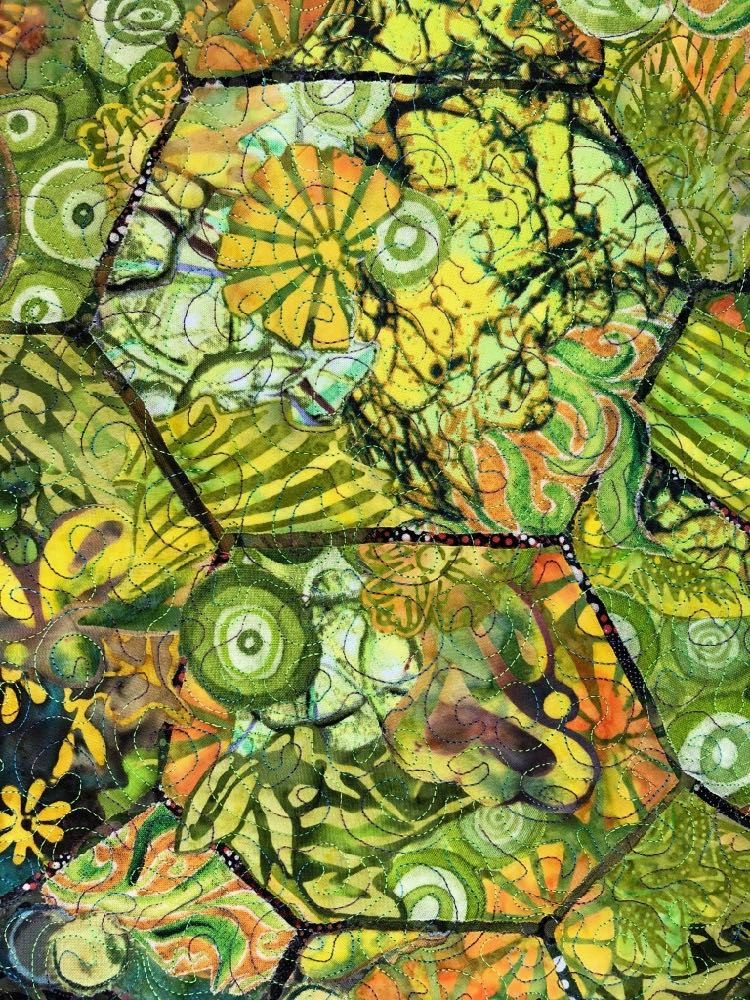
Something that isn’t obvious about fabric collage (as I teach it) is the importance of the sequence in which you approach the construction of your image. Where you start, and the order in which you proceed, can make a big difference in the ease of progress and outcome of your quilt.
Over the next few months I’ll be contributing to an ongoing series of blog posts that will discuss the best sequence to approach a fabric collage project using various quilt examples.
Recently I have been hard at work on my upcoming online eWorkshop, Susan Carlson Fabric Collage: Sea Turtle (above, in progress). The shell of a turtle presents thin lines in its design. It is similar in fact to another quilt I made, “Monarch Maia,” which features a portrait combined with the wings of a monarch butterfly.
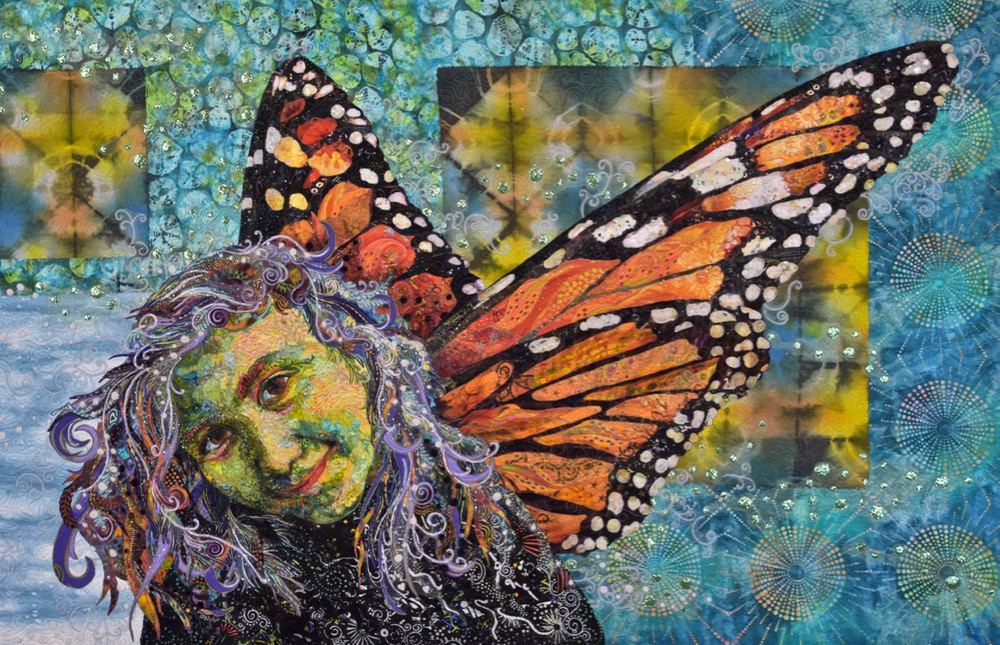
The Monarch wings in that quilt were made in a very similar fashion to how I demonstrate making the shell on the sea turtle in the new eWorkshop.
In each case, panes or plates of color are surrounded by thin dark lines. Working the way I do, the full-size pattern based on your image is traced onto a plain foundation fabric. The temptation for many, when faced with such lines in their design, is to cut a dark fabric to cover the entire wing or shell first, then add the colored shapes on top.
The problem with this approach is that once you have placed the large dark color over the entire wing or shell, you’ve obscured the other shapes that you have drawn on your foundation fabric. How do you fill in those shapes if you’ve covered them up?
The answer would be a template approach—trace the shapes, number them, cut them out, pin them to your choice of fabrics, cut them out again, and figure out where to place them on that solid piece of fabric. Let me say right now that it’s not “wrong,” it’s just not how I approach fabric collage, and how I teach it.
I developed this form of fabric collage in my quest to make the process of creating an image in fabric more immediate, more painterly, less paint-by-numbers. I wanted to look at my subject and immediately respond by free-hand cutting and placing fabric directly onto a foundation fabric. Templates were, to me, a hindrance for how I wanted to work.
So how do I approach creating a butterfly wing or a sea turtle shell?
I start with the panes or plates first. Instead of creating these smaller shapes with one piece of fabric, I like to use several, depending on the size of the given area to fill. This to me gives the piece a richer more interesting look—like multiple dabs of paint—not at all the single color of a paint-by-number. As I glue the fabric pieces down I make sure that I leave their edges, especially those at the edge of the plate or pane, loose. Once the panes or plates are completed, I go back and slip strips of fabric between them and under the loose edges, again using not just one fabric for the contrasting lines, but as many as I like, depending on the look I’m trying to achieve.
In the photo below of the turtle shell from my eWorkshop, I’ve cut a sliver of brown and black fabric to slip into the gap between the plates. I have left the edges of the plates loose and cut the fabric sliver wider than the gap itself in order to ensure that the foundation fabric is covered and the gap is filled.
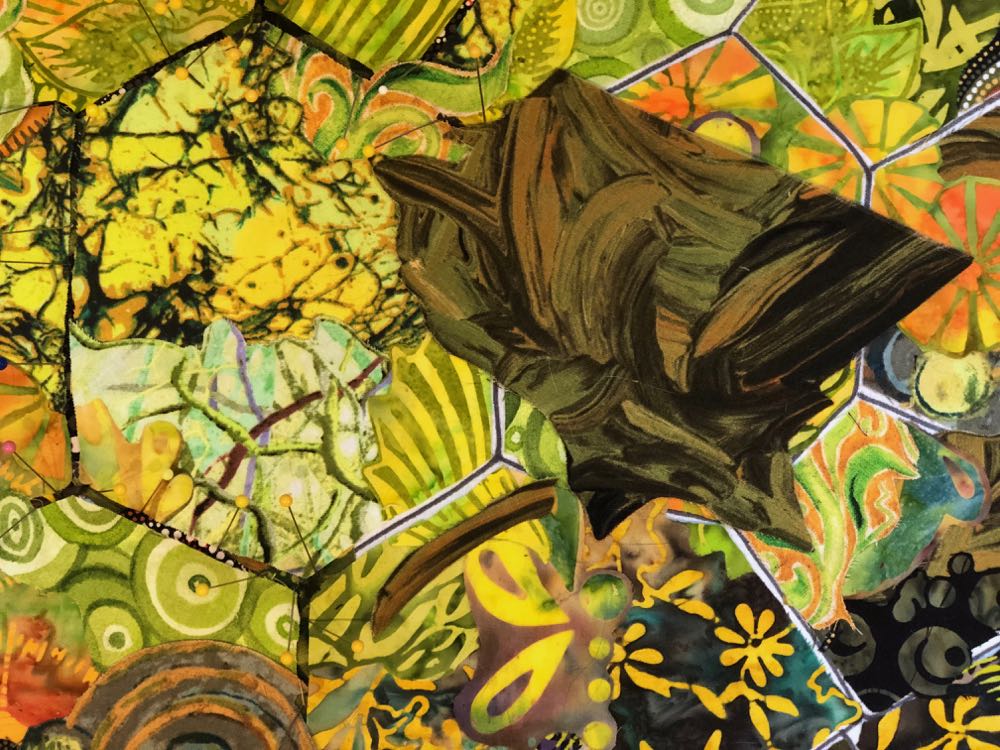
Here that sliver of fabric has been placed between the plates.
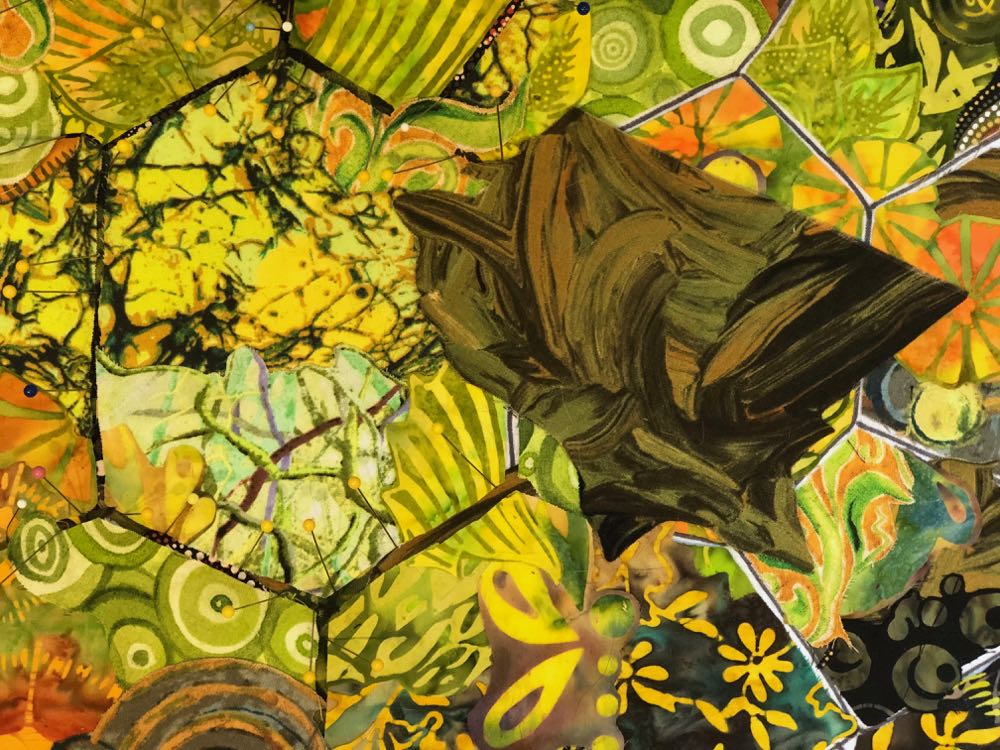
Note that I choose to vary the color and value of the fabric I use to fill the gaps. I do this to add interest, but more importantly to ensure that the plate and the gap fabrics have contrasting values. This is something that would be near impossible to preplan if you placed a large dark fabric down first then created the plates on top of it. And again, you’d need to resort to templates.

In the video excerpt below—a preview from the eWorkshop—I demonstrate how I choose, cut, place, and glue the strips of fabrics to fill the gaps between the plates on the turtle’s shell.
For another demonstration of this technique and other techniques for creating very fine lines, visit a previous blog post: “Get in Line: Skinny Lines in Fabric Collage.”
I like to work this way both because of the sense of (relative) immediacy it gives me and because of the customized results I get. Basically, ’cause I like the way it looks when I’m done.
Monarch Wing Example
In the following photos I show the sequence in which I approach the wings—specifically the lower part of the right wing—in this fanciful portrait of my niece, entitled “Monarch Maia.” I’ll be referring to the two parts of the right hand wing—please note that the lower part overlaps the upper part.
Below, the pattern I created has been traced onto a foundation fabric. My next step is to decide where to start. Where would you start?
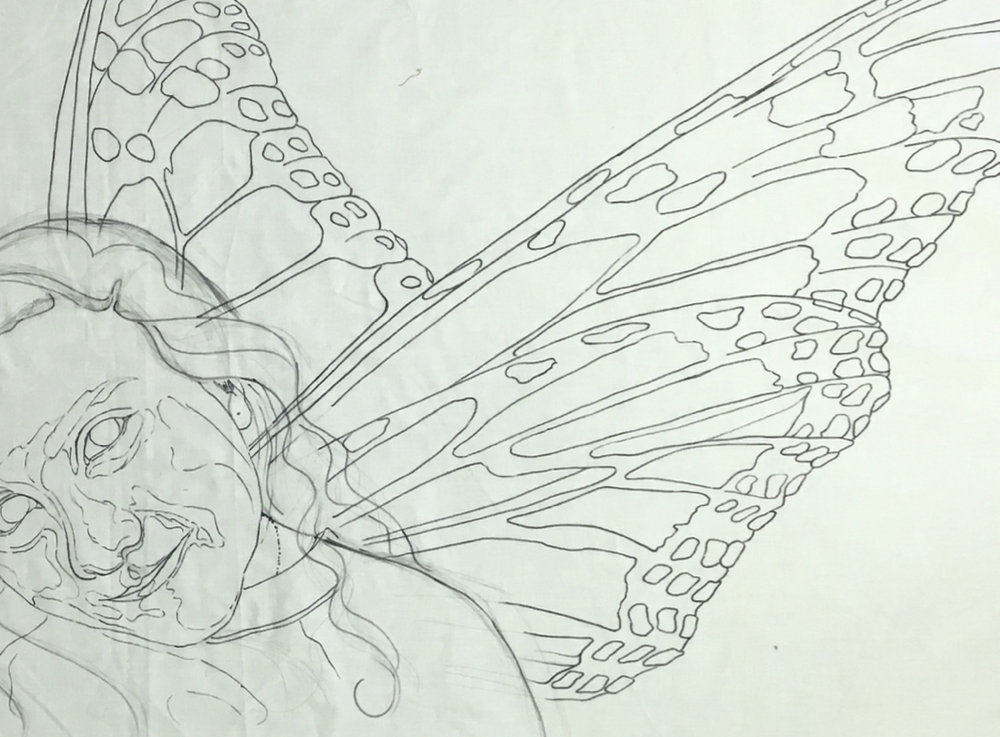
Here’s the answer: you start with what is in front. I started with her face—specifically the nose, eyes, and mouth— because that is what is in front of the wings.
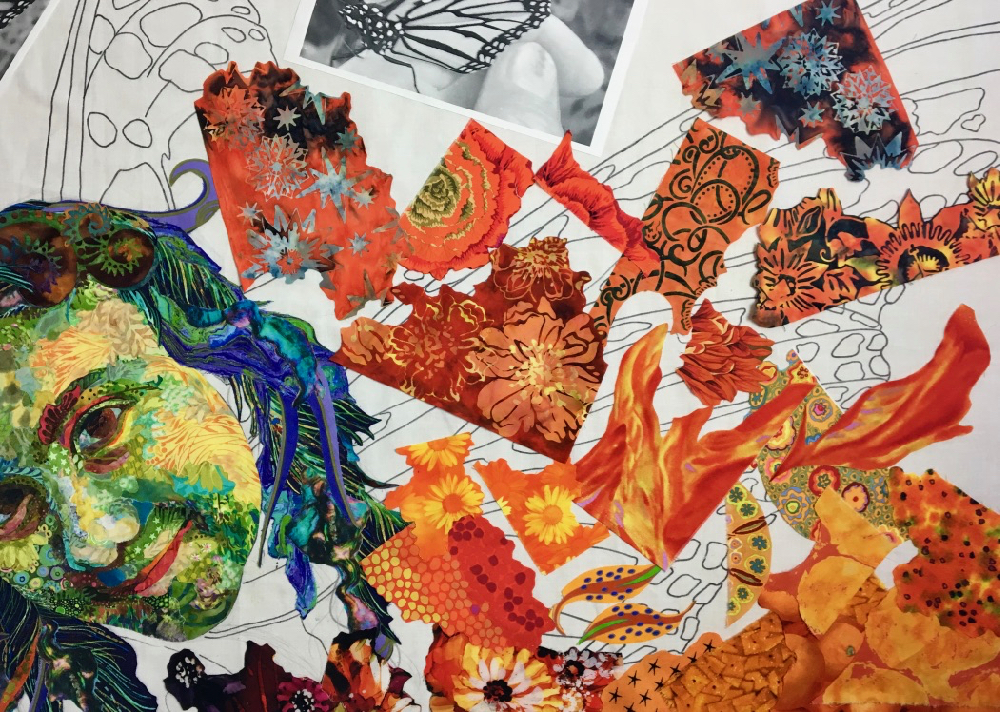
Now that the first draft of the face and then hair is done, I keep moving backwards on my subject to the wings, which are behind the hair. The lower right wing is in front of the rest of the wings, so I begin with that one. And on each part of the wings, I begin with the orange “panes.” Why? Because they are in front of the dark lines.
By choosing to work with the shapes that are in front of others first, I can see exactly where the orange shapes fit and what shape they should be. I retain the ability to work with my drawn lines and take full advantage of the work I put into the design.
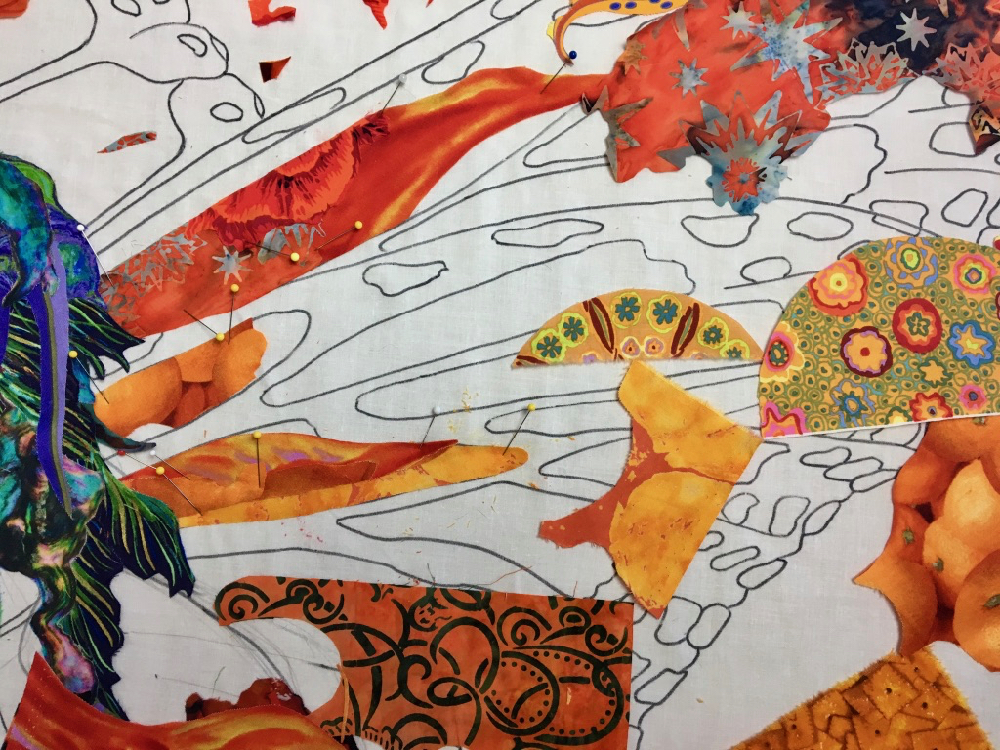
I do use several pieces of fabric to fill each pane. The use of multiple fabrics allows me to blend easily from one value to the next—dark to light— and I feel the variety of prints gives a richness to the visual texture of the piece.
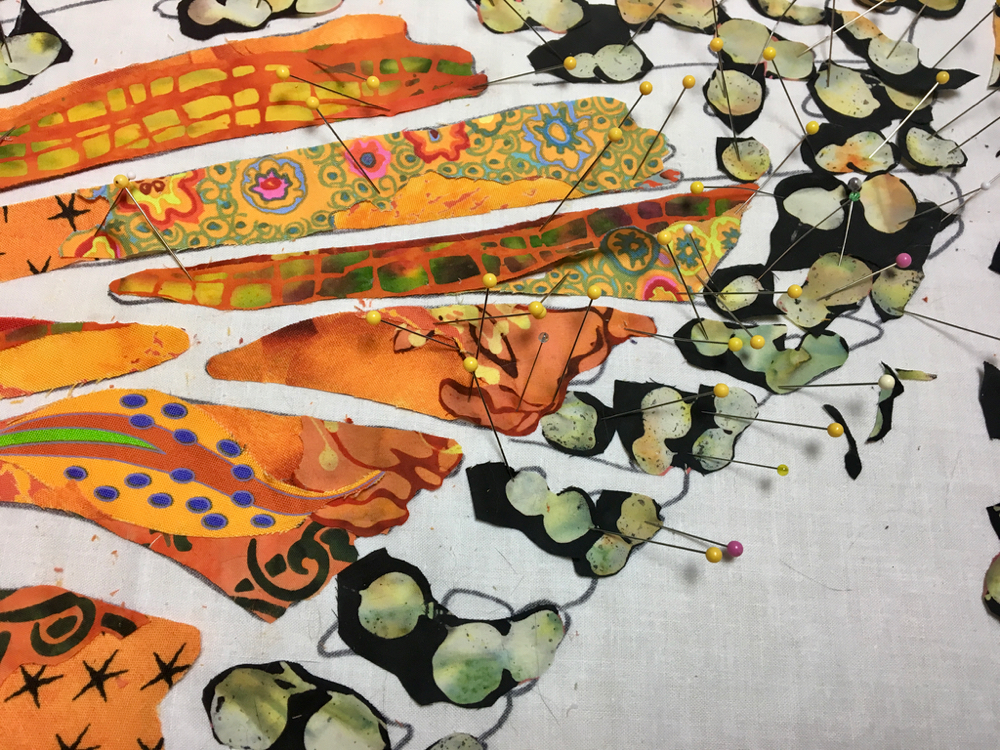
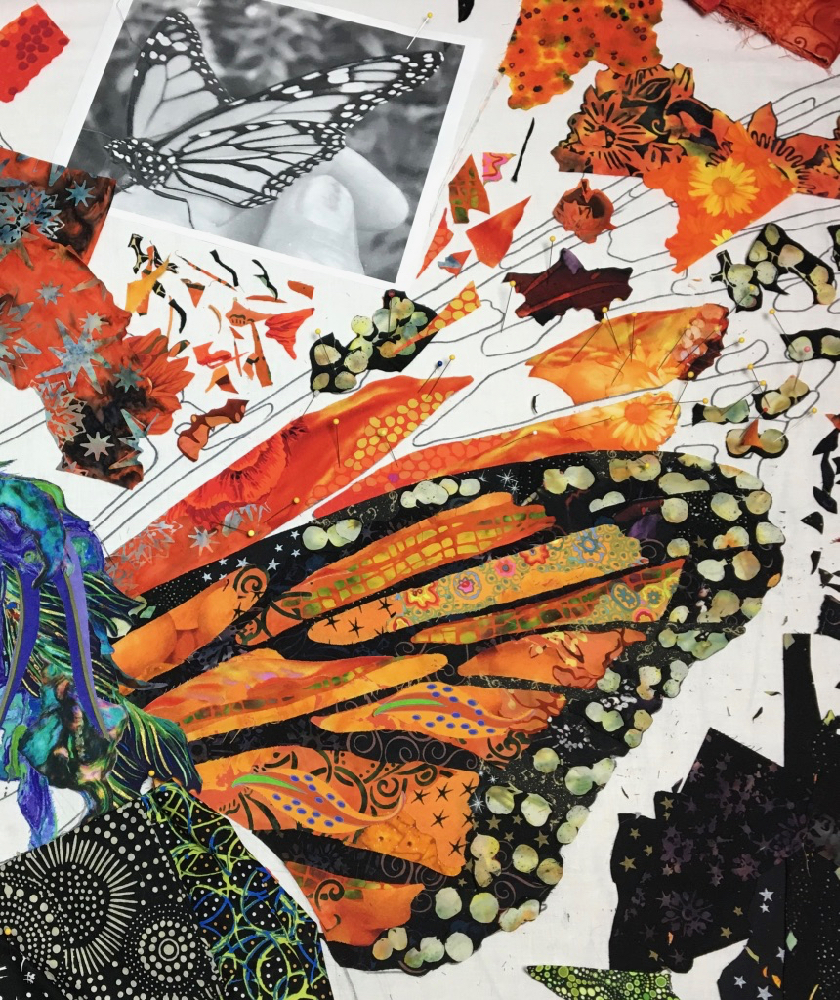
In the photo below I have completed a first draft of the orange panes on the lower right wing, but because of all the pins, I can tell they have yet to be glued in place.
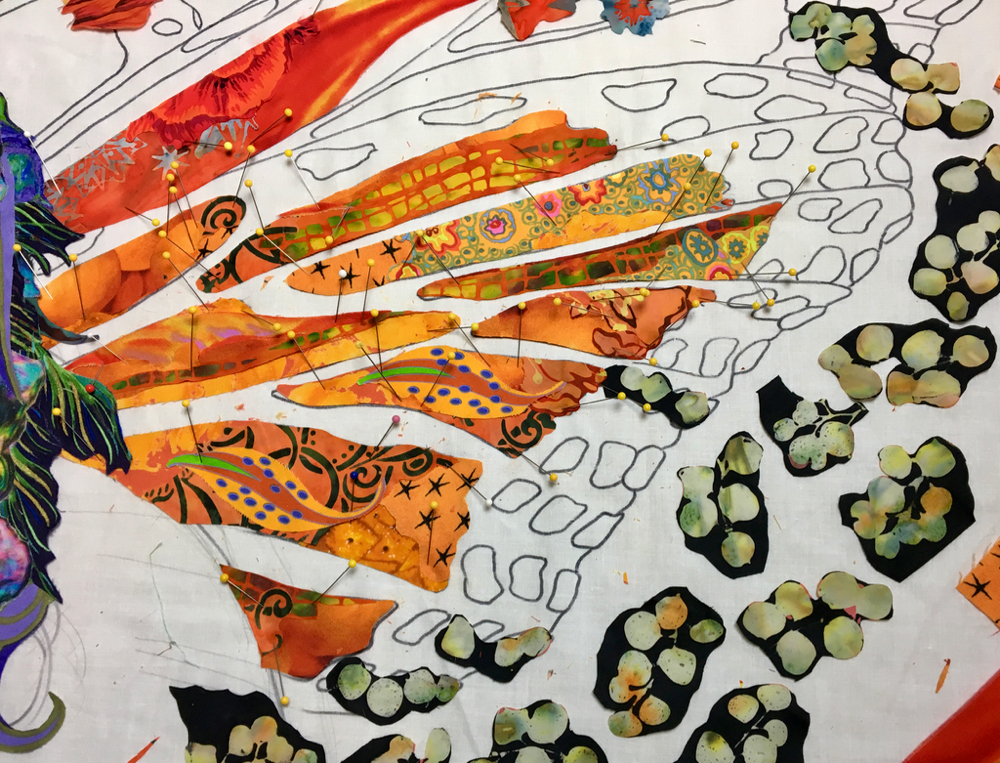
I have also cut down groupings of “white” spots from another fabric, picked to represent the white spots of the Monarch wing edges—which are also in front of the black background of the wing. I leave a little of the black print surrounding the white spots, it saves me some work and will eventually blend with the rest of the black fabrics anyway.
All these fabrics shapes are still in front of the (eventual) black wing background. Here the first draft of the panes and white spots is complete. As I glue each piece of fabric onto the foundation, I tack only the centers with glue, leaving the edges loose, which will allow me to slip the dark fabrics behind either the orange or white shapes.
This way of construction makes sense to me and seems very logical—what’s in front overlaps what’s behind, right? Create the orange panes and white spots (what’s in front) first, then tuck the black behind.
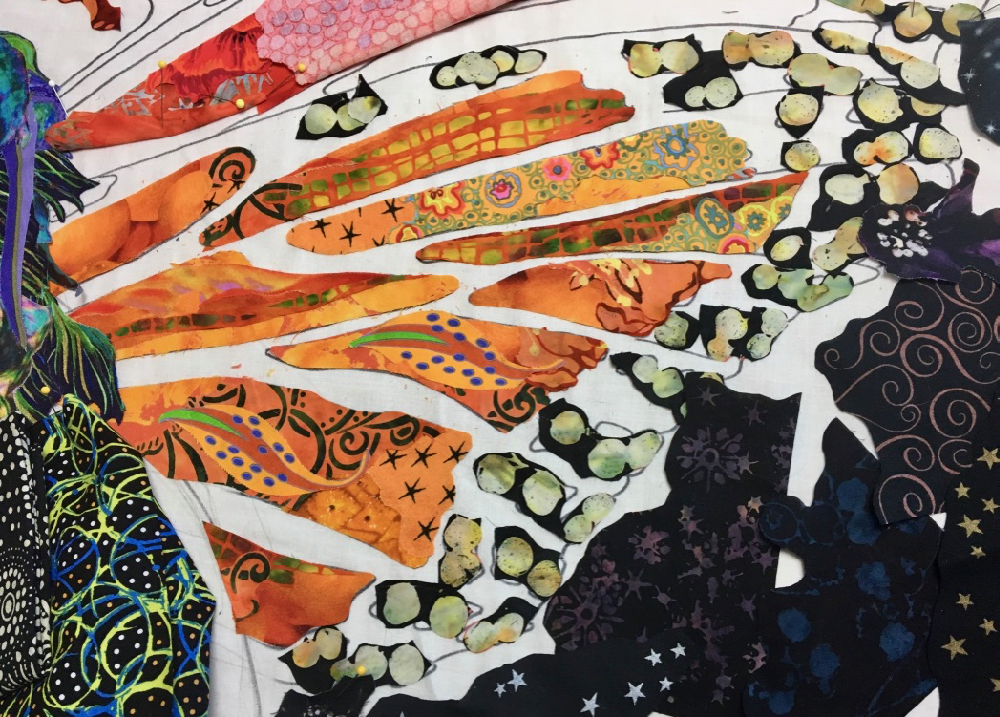
Note in photo above the many different varieties and patterns of “black” I plan to use.
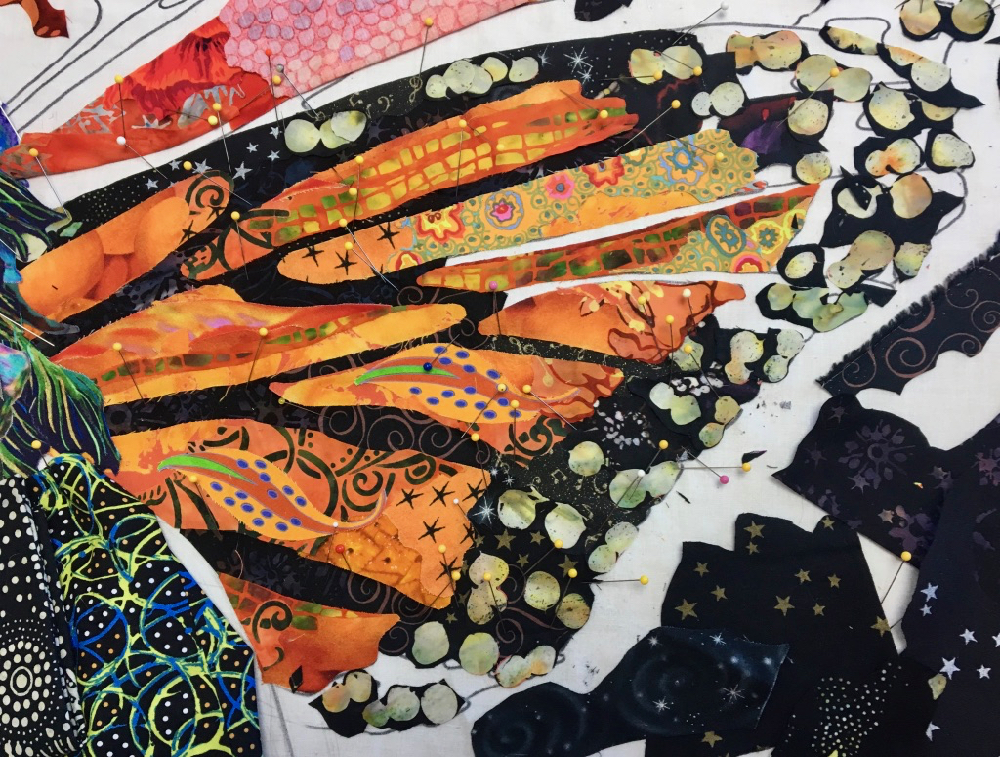
The first draft of the dark background is in progress above and below. It moves quickly since I’ve already done the work creating the orange and white shapes. The black bits of fabric just slip under those shapes and fill in the open spots on the foundation fabric.
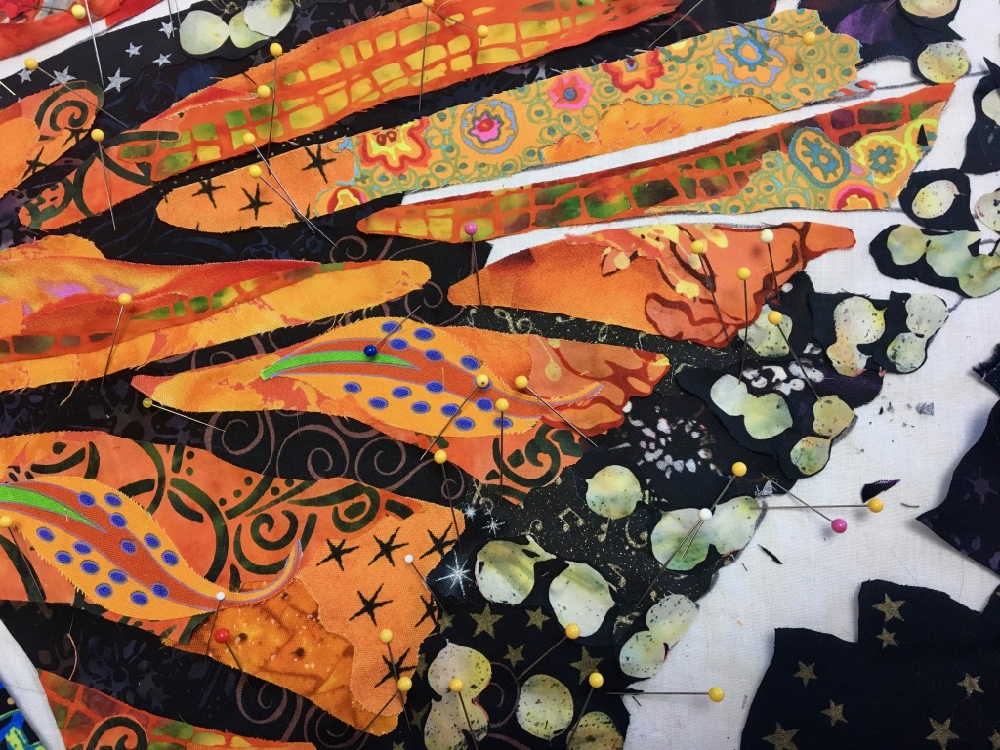
Below, the first draft of lower wing is now complete. I make sure I’ve trimmed the black upper edge to my drawn line before I move on to the top wing section—the next area in my front to back sequence. Once that line is defined and the black fabrics secured with some glue (keeping edges loose), I can start tucking the orange fabrics of the upper part of the wing behind the lower part of the wing and repeat the process.
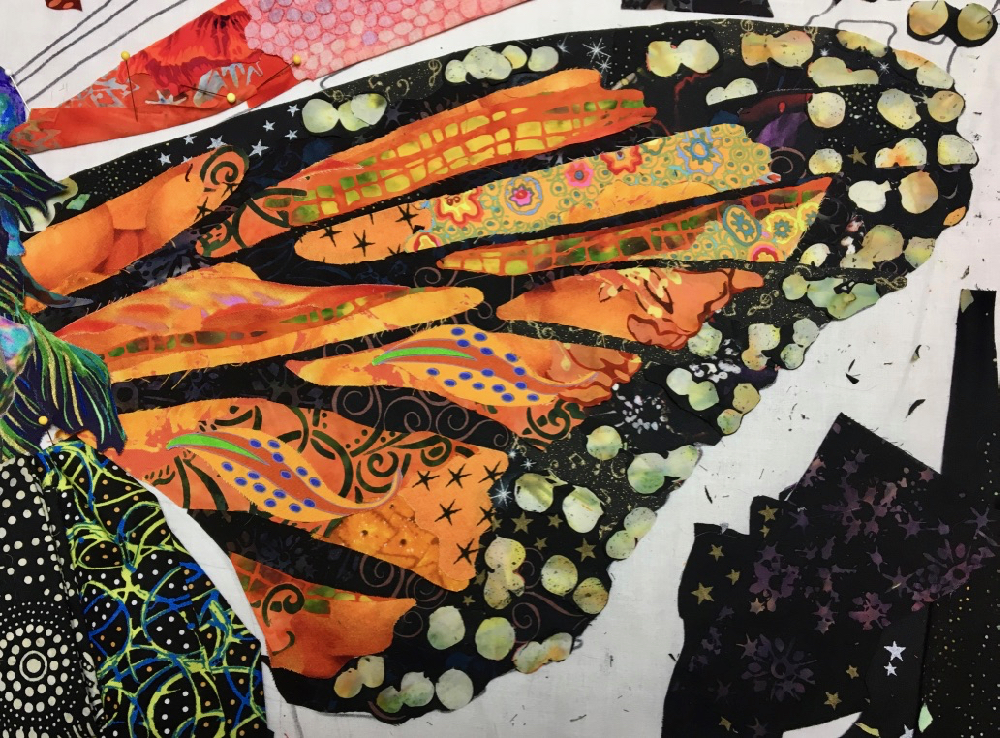
Below I’m making progress on the upper part of the front wing. The orange panes abutting that black edge tuck right underneath, the contrast creating a smooth, definitive division between the two parts of the wing. Check out more in-progress photos of “Monarch Maia” here.
Stay tuned for more examples of this—start with what’s in front—fabric collage construction sequence using other quilt subjects in following months.
Addendum to Sequence in Fabric Collage
The month that the above, Sequence in Fabric Collage Part 1, was written and published, the Covid pandemic also came into being. Like many things for all of us, plans for 2020 were rearranged. New Sequence posts did however get written and posted, in 2021. You can read them in the links below.
Part 2: Faces—originally published February 20, 2021
Part 3: Using Sheers—originally published March 6, 2021
Susan’s Fabric Collage Class Schedule
July 2026: 5-Day Live Online Fabric Collage Class via Zoom!
REGISTER HERE and attend from your own home
July 13-17, 2026
More about my 5-Day Online Fabric Collage Classes
From past online student, Sylvie Aguilar:
When the on-line classes started, I hesitated before signing up. Not being a very tech savvy person, it scared me. I also thought it would be a very long zoom day. After procrastinating for a couple weeks, thinking I didn’t know enough about collage, with my daughter’s encouragement I signed up. That was the best decision I made! What a fantastic class. I learned so much more than anticipated. Susan and her husband Tom, are a great team, and so generous with their time and knowledge. From day one, they made us feel at home. It was like we were all part of a collage artist family. It was so comforting to feel part of a community of fabric artists that understood you and got excited about the same things you did.
September 2026: Susan Carlson Fabric Collage in Bar Harbor, Maine 2026
A week-long class on the doorstep of the breathtaking Acadia National Park, Bar Harbor, Maine
September 14, 2026 – September 18, 2026
FOR MORE INFORMATION
April 2027: Strada Toscana—Serendipitous Fabric Collage with Susan Carlson
A week of fabric collage and cultural field trips in the Tuscany Region of Italy
April 18-23, 2027
FOR MORE INFORMATION
September 2027: Woodland Ridge Retreat—Fabric Images
Five days of fabric collage in this cozy retreat in Downsville, WI
September 21-25, 2027
FOR MORE INFORMATION
Susan Carlson Ongoing Open Studio Hours
Weekly Fabric Collage Coaching
1/2 hour time slots, $65 each
One afternoon a week, I’ll be available to help, encourage, and coach anyone who needs it—between the hours of 1pm-4pm Eastern Time (for instance, this would be between 10am-1pm Pacific Time).
Coaching could be to continue working on an in-progress collage, or to begin a new project—whatever is desired.
Sign-up can be for one day or multiple days—every week, every two weeks, once a month or once only. These sessions will be recorded and emailed to you, just as coaching sessions are, so they can be referred to as needed.
Sign up for time slots here
Please note that times are listed in Eastern Time!
Simply click on a slot and type in your name, Tom will bill you before your session.
Please contact Tom ([email protected]) so he can contact you with more instructions.
July/August 2026 Dates
Tuesday, July 21
Tuesday, July 28
Tuesday, August 4
Tuesday, August 11
If you are interested in this sort of coaching but Tuesday is not a day that would work for you, just drop us an email and we can figure something out ([email protected]).
From an Open Studio Hours participant who also recently took a class with me:
I can’t recommend enough this new format. I’ve met with Susan three times since our class (once a week) and each session has been inspiring, motivating, and very helpful in terms of defining my path forward (and also creating some accountability relative to that path…). Before each session, I think about what areas I would like to focus on and send off a photo with my questions. In this way, I get from Susan exactly the support I need, plus a video recording to remember it. Meanwhile, preparing for my session helps me make my project a priority so I see ongoing progress, which is gratifying.
Honestly, this was the format I was hoping for. I told Susan I wanted to write a testimonial about it because I was so happy she was offering it. So, if you’re like me and a periodic check-in keeps you learning, growing, and doing your best work, sign up for coaching. Maybe I’ll see you there (you get to listen in on other sessions during the open studio you attend). —LeahGrace Kayler
Fabric Collage Online Master Class—Updated
The Susan Carlson Fabric Collage Online Master Class Manual is a multi-media resource guide to the process of fabric collage. Using video, photos, text, and links to my blog posts for further relevant reading and information, I take you from beginning to end in creating your own fabric collage masterpiece, following my guidelines in a step-by-step format. Lifetime Access. Suitable for all levels, including beginners.
Read all about the process of creating the Master Class—explanation of its genesis—the whys and hows Tom and I made some of the decisions we did in this post: Online Master Class Now Available: Some Reflections.
Click here for more information about the Fabric Collage Master Class.
Price: $199
Lifetime Access
Suitable for all levels, including beginners
Further Susan Carlson Learning Resources include: Facial Features eWorkshop, website, Serendipity Quilts, patterns, blog (in general), YouTube videos, Sea Turtle eWorkshop, Fabric Collage Online Master Class, Patreon. , and our February Fantastical Fish and Summertime’s Fascinating Bugs and Butterfly Work-Alongs
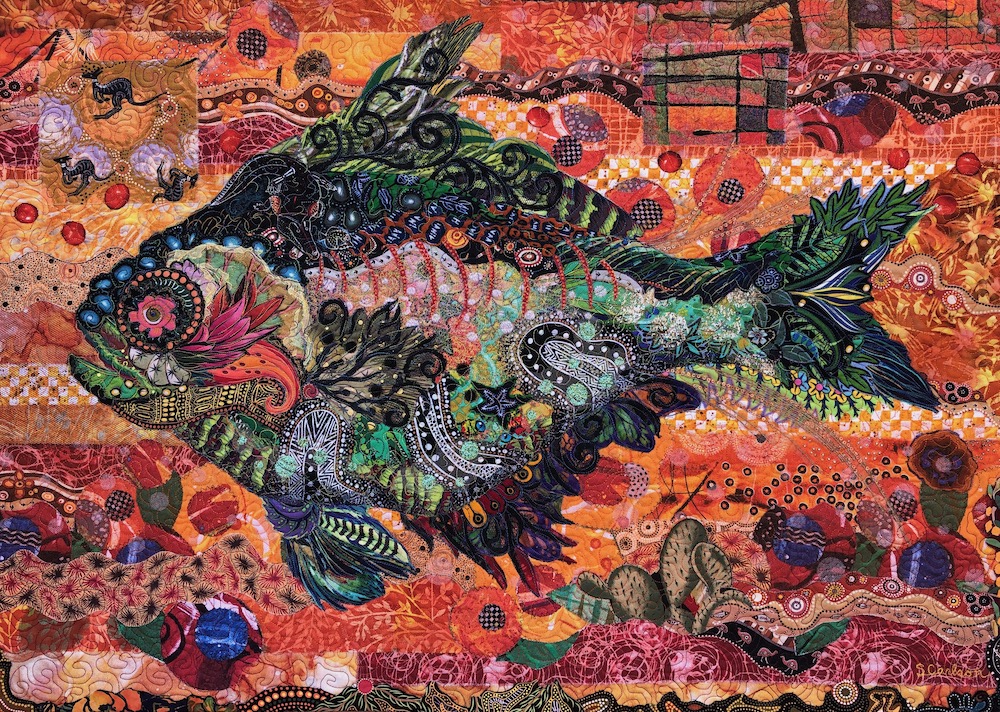
Susan Carlson Fabric Collage: Fantastical Fish eWorkshop I
INCLUDES:
• All four recordings from the four-week class.
• Extended 10-minute edition of piecing time lapse (see below).
• Over six hours of video instruction.
• Annotated videos with “jump points” to help find the information you need.
• Materials list
• Links to helpful blog posts.
• Free fish pattern of your choice.
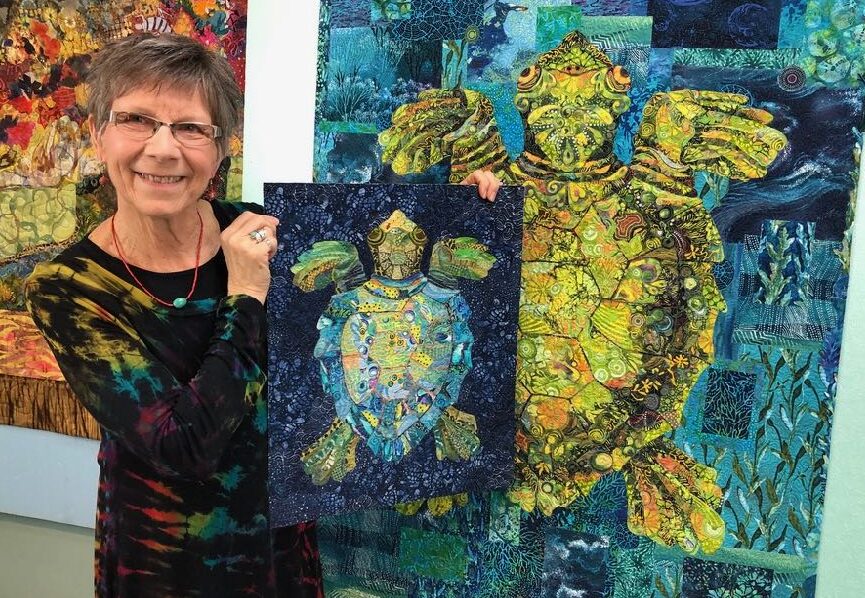
Susan Carlson Fabric Collage: Sea Turtle eWorkshop
Learn fabric collage through a start-to-finish project—from pattern and fabric selection through quilting and binding. Each step is clearly written, illustrated with photos, and further demonstrated with videos. Learn the technique with a Sea Turtle then launch into any fabric collage project you wish. Lifetime access and suitable for all levels, including beginners. Sea Turtle Pattern included
Read all about the Sea Turtle eWorkshop in this blog post: Fabric Collage Sea Turtle eWorkshop Launch.


Facial Features eWorkshop
Designed as a supplement to the Fabric Collage Online Master Class, or for those who have a good understanding of the basics of Fabric Collage. Lifetime Access. Intermediate or advanced levels suggested.
The Facial Features eWorkshop contains 8 videos and over 8 hours of in-depth instruction for creating each feature of a portrait in fabric. The videos are annotated with “Jump Points” allowing you to scan forward and backward to the information you need. Facial features PDF templates are included as reference and basic designs to work along with. Like the Fabric Collage Online Master Class, membership in this eWorkshop is for life.
Book: Serendipity Quilts—Cutting Loose Fabric Collage
Full color throughout. Five projects of increasing complexity, four patterns to enlarge are included.
These books will be signed by Susan and can be inscribed to a particular person.