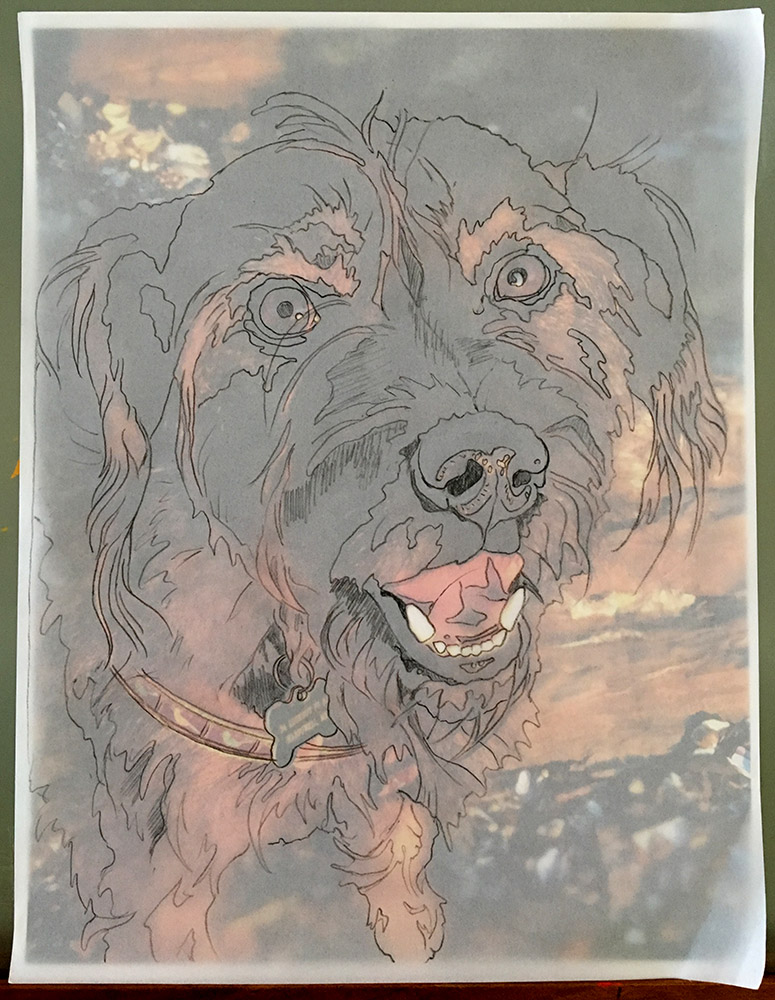
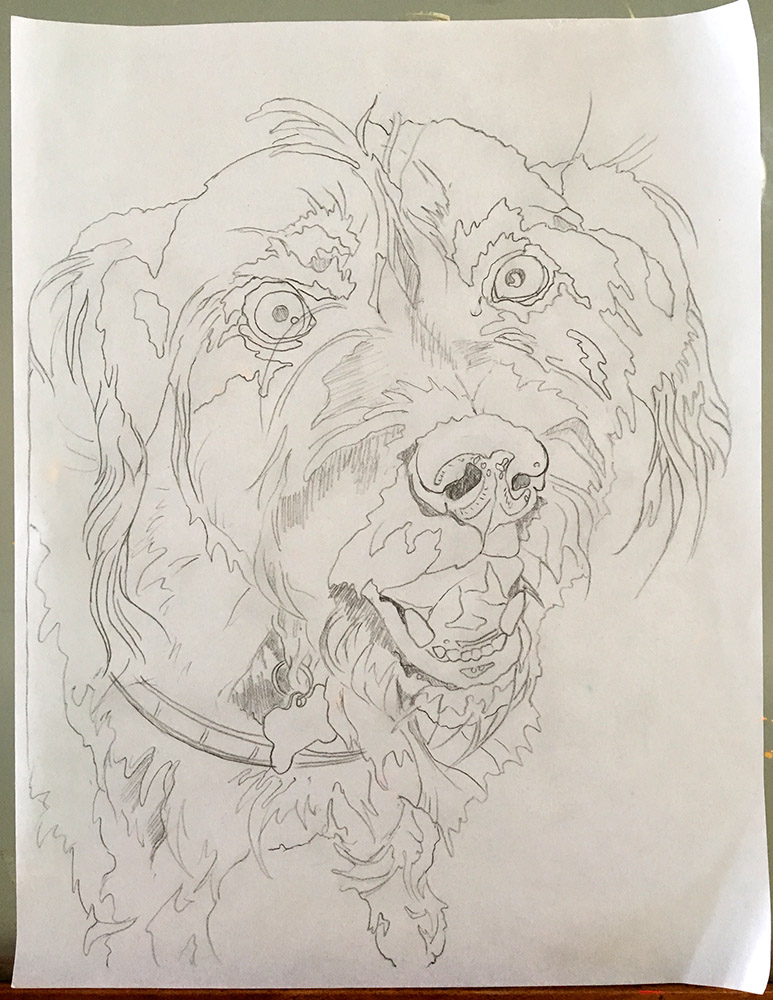
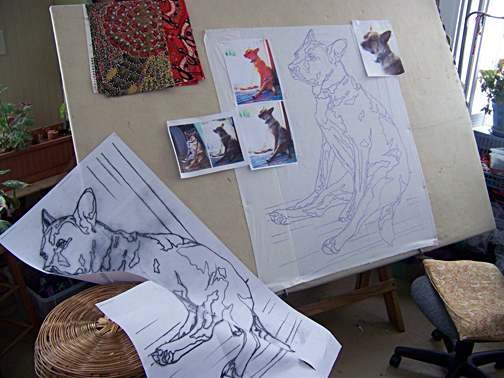
In today’s Throwback Thursday post, you’ll get up-close and personal with one of our pups, Felix, that’s him above. In this post, Felix becomes my subject for a line drawing that will become a pattern for his (future) collage portrait.
So far in our special summer fabric collage how-to series, we’ve concentrated on choosing a subject and selecting a photo of that subject. Today is when that prep work starts to pay off. Making a pattern for a collage is much easier when you have chosen a good photo—when the lights and darks are nice and contrasty—and the image itself is good and sharp.
One big tip I have for you in this Throwback Thursday post is to NOT enlarge the photo you’re working from to its finished size in order to create a line drawing (tracing) as a pattern. The reason you don’t make a pattern from an enlarged photo, is that in the process of enlarging the photo you’ll lose detail, the photo will become fuzzy and all the more difficult to draw a pattern from.
Here are the links to the Fabric Collage Summer Special posts in this series so far.
Susan Carlson Fabric Collage Throwback Thursday Summer Special—1 of 14: Choosing a Photo
Susan Carlson Fabric Collage Throwback Thursday Summer Special—5 of 14: Creating a Fabric Palette
Susan Carlson Fabric Collage Throwback Thursday Summer Special—6 of 14: Sequence
Susan Carlson Fabric Collage Throwback Thursday Summer Special—7 of 14: Sequence in Portraits
Susan Carlson Fabric Collage Throwback Thursday Summer Special—8 of 14: Using Sheers in Sequence
Susan Carlson Fabric Collage Throwback Thursday Summer Special—9 of 14: Background Stories
Susan Carlson Fabric Collage Throwback Thursday Summer Special—10 of 14: Sheer Curiosity?
To dive a bit deeper, the information in this series has been gathered, reorganized and expanded upon in our online learning resource the Fabric Collage Master Class. For more information about the Master Class, click the button below.
Making a Pattern for Fabric Collage
UPDATE (Published on February 18, 2017)
As promised, I’m selecting some of the most popular posts from my blog and updating them with video—something that elaborates on or shows more detail in the fabric collage technique. Starting with the most popular posts—the ones that have been viewed, shared, and commented on the most—this is now the second installment of the “Update Series.”
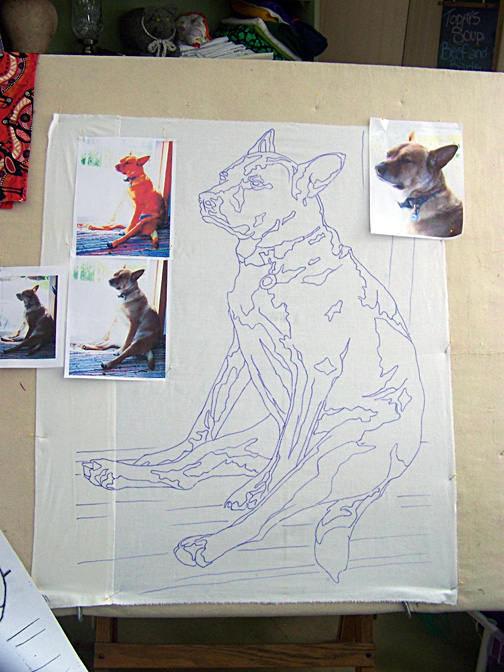
This particular post originally began and ended with drawings of a past pup of ours (Pippin), so I choose an image of a current pup, Felix, to demonstrate via video the pattern drawing process.
Felix is a dark dog–an easy description would be dark grey–not an easy subject to photograph. Add to that his camera shyness and we have many pics of him as a dark blur. So imagine my delight when a beautiful sunset walk at the end of the peninsula we live on yielded a sun-soaked photo of our wonderfully shaggy three-legged happy dog.
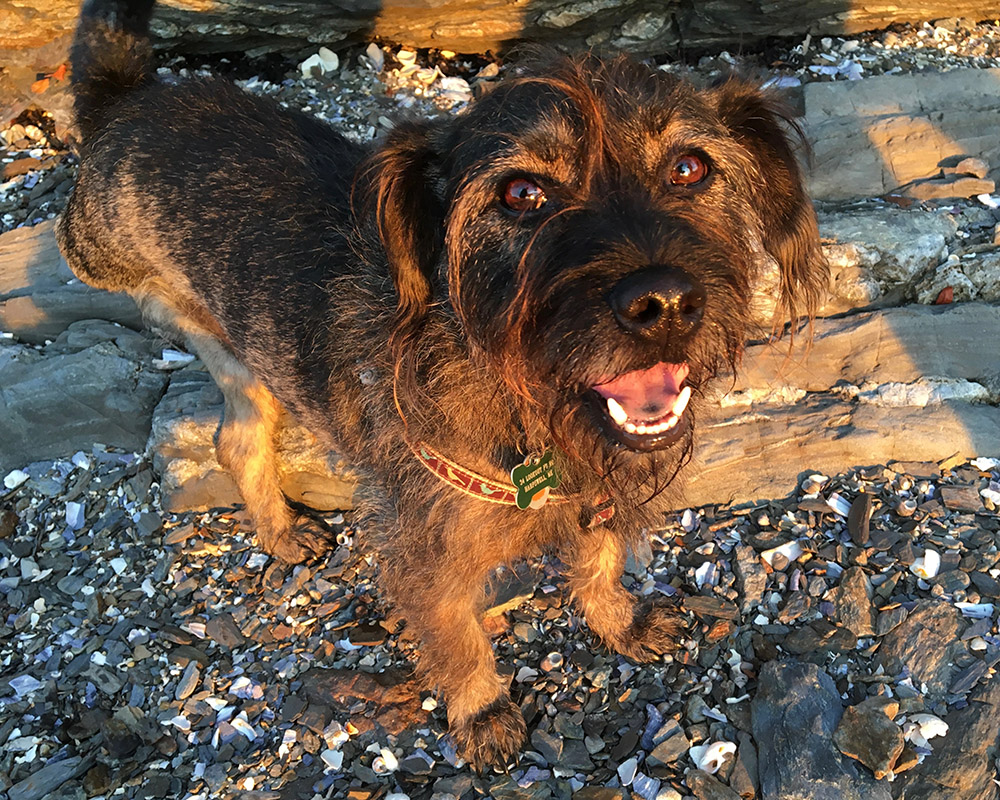
This photo accented the few browns on his face and gave me the highlights and shadows I would need in creating the line-drawing for the pattern, as well as definition to his face and body to guide me later in the collage process itself.
Click on any smaller gallery photos to view them larger and to scroll through the gallery.
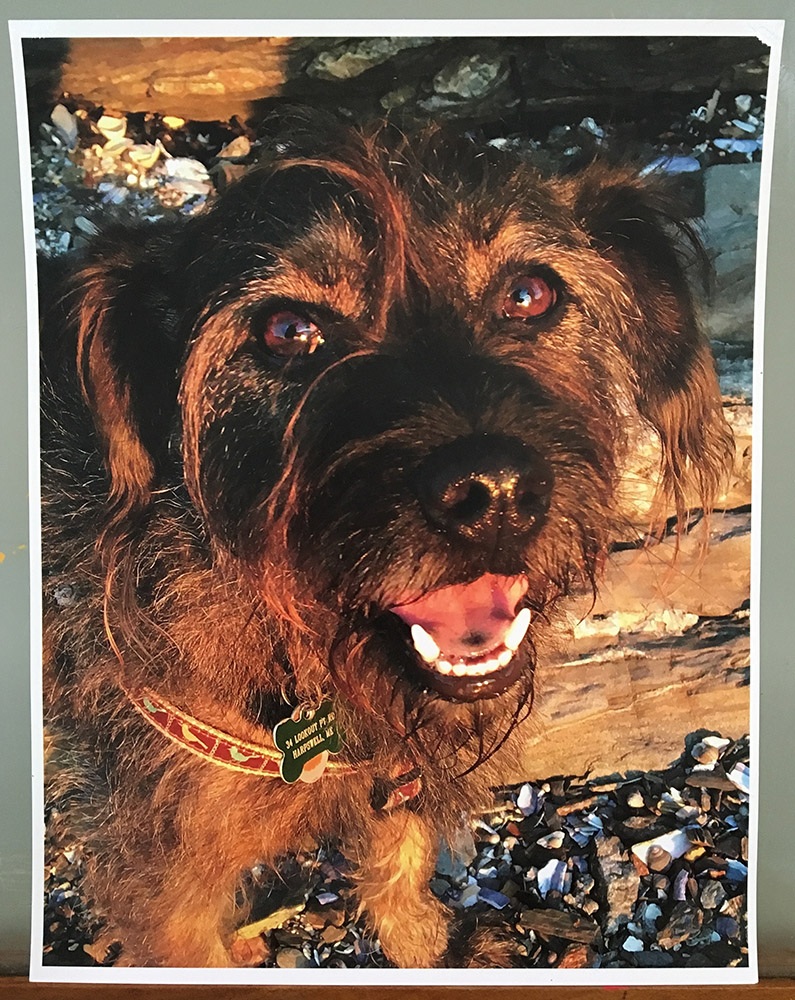
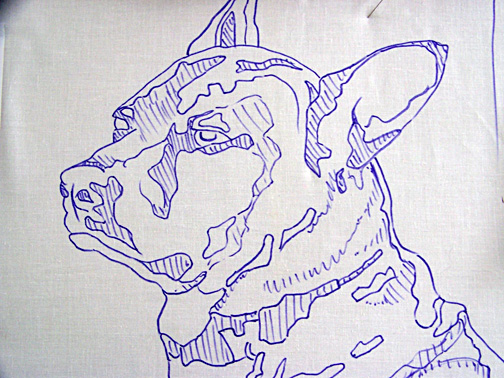
As I say in the original post, in creating a line drawing, I begin by looking for the lights and darks of the image. I outline those areas, taking care to be as accurate as I can. This might take me a while, but I find that time spent looking at, drawing, and generally familiarizing myself with my subject is in no way wasted. The more ways I can put the image into my brain, the better. I think it helps all along—from design to fabric selection to the collage process itself.
And here—tah dah!—is your video. Enjoy.
ORIGINAL POST
(First published on April 2, 2016)
So you want to make a fabric collage quilt. Great!
After choosing an image to work from, the next step in creating a fabric collage quilt is making a simple pattern. This is a critical step, one that even beginning students sense has an enormous influence on the success of their finished product. Knowing how much is riding on creating a suitable pattern may make this a daunting task to the beginner.
It doesn’t need to be scary.
The basic steps are simple:
- Enlarge selected image to letter size: 8½ x 11 inches.
- Use tracing paper to outline shapes based on value.
- Enlarge tracing to desired size of completed quilt.
- Transfer outline to foundation fabric.
Okay, so you can go deeper than that, but that’s the basics. Let me elaborate by using a few of my own quilts as examples.
To see final versions of the quilts: “Kissing Cousins” is featured in a previous blog post: A Christmas Gift that Keeps on Giving. “Peace, Love, Tie-Dye, Save the Whales” is featured in my blog post on value: Why Color Is Irrelevant. “Dixie Dingo Dreaming” can be viewed on my website.
Step One: Enlarge selected image to letter size: 8½ x 11 inches.
Letter size is nice because it’s convenient. Most people have home printers nowadays, so it’s easy to print out an image as big as will fit on a regular piece of paper.

Why not bigger? Why not print out the image at the finished size? That seems logical. The bigger you print it out the easier it is to see details, right? That might be true if you have an extremely high resolution image. But the resolution on most personal and cellphone cameras just isn’t that great. If you blow up an image too much, you’ll actually lose detail.
Keep the original handy. You’ll be referring to it during the piecing process.
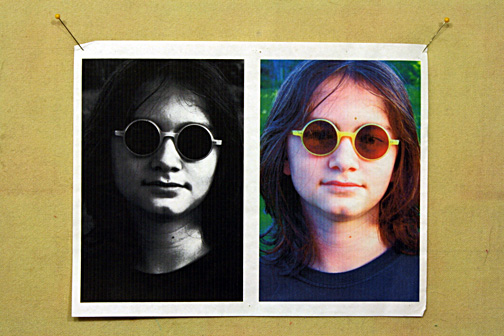
Extra credit: In order to draw out the differences between shades of value, you might try tweaking the brightness and contrast in a image manipulation program such as Photoshop before printing out your image. You could also try turning it black and white, posterizing it, or playing with changing its colors. These all may help you see the image as a collection of values.
Step Two: Use tracing paper to outline shapes based on value.
Tracing vellum is nice and transparent, if you can find some, but regular old tracing paper will do if that’s what you have. Using a nice, sharp pencil (I like mechanical pencils for this), start outlining the larger shapes based not on, say, parts of a face—nose, mouth, eyes—but in terms of value. A nose will be made up of several shapes—dark, medium, and light areas. If you need a refresher on value, visit my blog post “Why Color Is Irrelevant.”


Resist the urge to be extremely detailed. It will simply be too confusing. Also, as you will see in the example of “Dixie Dingo” (below), the pattern will get covered up quite quickly, making all those details a waste of time. If it starts looking like a crazy paint-by-number drawing, then you probably have too much detail. Look for lightest areas and darkest areas to draw around. The middle values get filled in as the piecing process progresses.

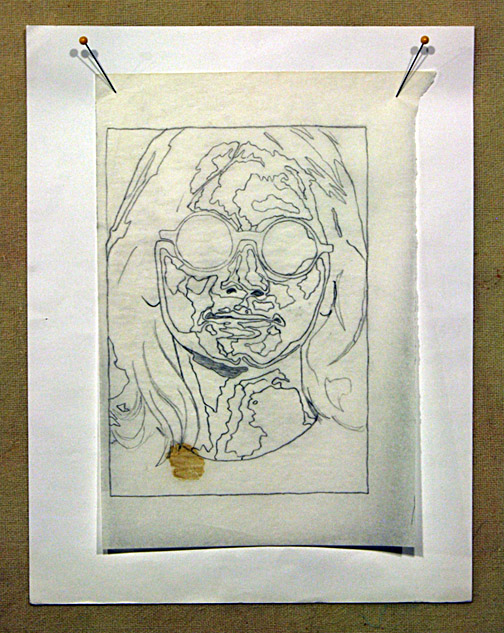


Extra Credit: Do simple shading in the darkest shapes to indicate shadows. A lighter shading can be added to shapes where the value is in the mid-tones. Leave the highlights white. This drawing, after you transfer it to the foundation fabric, can serve as a “cheat-sheet” of sorts and help you keep track of what values go in what shapes.
Step Three: Enlarge tracing to desired size of completed quilt.
When in doubt, go big. How big? One rule of thumb: a face should generally be at least 10 to 12 inches top to bottom. Even bigger is better. Imagine trying to create an eye the size of your pinkie nail. Now imagine it the size of a golfball. Make it easy on yourself and go bigger.
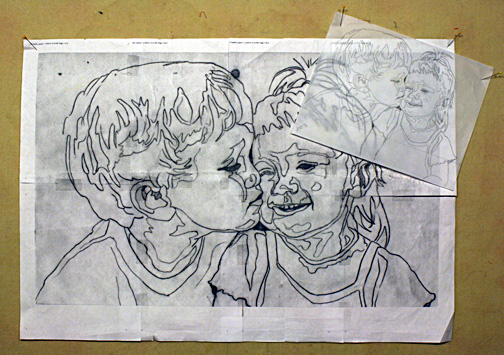
The easiest way to get your tracing enlarged is to take it to a local copy shop. Most big box business supply stores have a copy center. Tell them how big you want the finished pattern to be and let them do the math.
Another method is to enlarge it at home. This will require you to scan your tracing, then print it out at whatever percentage you desire. This will probably require you to “tile” the image together in several pieces. I do this with all my designs (see photo above and”Dixie Dingo” photo at beginning) since I have in-house copy service, a.k.a. Tom, my husband.
So how do you figure out what percentage to use? Simply divide the finished size by the original size then multiply by 100. It doesn’t matter which dimension, height or width, you use as long as you choose the same on both finished and original. Another way to figure out your enlargement is to use a proportion scale. And of course there are apps for that.
Step Four: Transfer outline to foundation fabric.
Choose a plain, regular weight fabric for the foundation that you’ll be gluing to. Muslin, or another inexpensive neutral colored fabric, works well. Cut a piece slightly bigger than your paper pattern. When you slip the pattern behind the fabric, you should be able to see it well enough to use a permanent marker (such as a Sharpie) to trace the image onto this foundation. You want a nice solid, definitive line. This is your guide and reference. There are no templates in the way I work.
Extra Credit: If you shaded in the darker areas on your pattern, transfer those to the fabric as well.

Final Exam
Students are often impatient to start creating their image in fabric, but don’t rush your pattern. Take your time. Maybe you’ll have to make a second draft, as I did with “Peace, Love, Tie-Dye, Save the Whales.” It’s well worth the effort at this stage to create an accurate pattern. As you move on to the the next step in the process—fabric collage piecing—a good pattern will ____________.
a. be the foundation on which your fabulous quilt will be built.
b. be your best friend.
c. give you extra confidence.
d. all of the above.
Fabric Collage Master Class
For instructions on the entire fabric collage process, you can purchase the Susan Carlson Fabric Collage Online Master Class. Using video, photos, and text I take you from soup to nuts, beginning to end in creating your own fabric collage masterpiece.
Susan’s Fabric Collage Class Schedule
July 2026: 5-Day Live Online Fabric Collage Class via Zoom!
REGISTER HERE and attend from your own home
July 13-17, 2026
More about my 5-Day Online Fabric Collage Classes
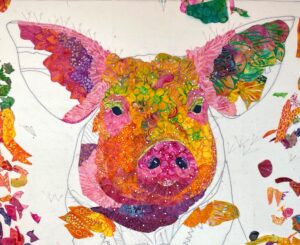
From past online student, Sylvie Aguilar:
When the on-line classes started, I hesitated before signing up. Not being a very tech savvy person, it scared me. I also thought it would be a very long zoom day. After procrastinating for a couple weeks, thinking I didn’t know enough about collage, with my daughter’s encouragement I signed up. That was the best decision I made! What a fantastic class. I learned so much more than anticipated. Susan and her husband Tom, are a great team, and so generous with their time and knowledge. From day one, they made us feel at home. It was like we were all part of a collage artist family. It was so comforting to feel part of a community of fabric artists that understood you and got excited about the same things you did.
September 2026: Susan Carlson Fabric Collage in Bar Harbor, Maine 2026
A week-long class on the doorstep of the breathtaking Acadia National Park, Bar Harbor, Maine
September 14, 2026 – September 18, 2026
FOR MORE INFORMATION
April 2027: Strada Toscana—Serendipitous Fabric Collage with Susan Carlson
A week of fabric collage and cultural field trips in the Tuscany Region of Italy
April 18-23, 2027
FOR MORE INFORMATION
September 2027: Woodland Ridge Retreat—Fabric Images
Five days of fabric collage in this cozy retreat in Downsville, WI
September 21-25, 2027
FOR MORE INFORMATION
Susan Carlson Ongoing Open Studio Hours
Weekly Fabric Collage Coaching
1/2 hour time slots, $65 each
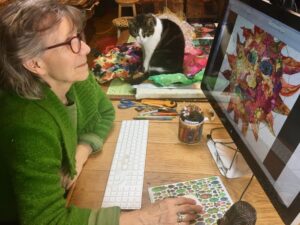
One afternoon a week, I’ll be available to help, encourage, and coach anyone who needs it—between the hours of 1pm-4pm Eastern Time (for instance, this would be between 10am-1pm Pacific Time).
Coaching could be to continue working on an in-progress collage, or to begin a new project—whatever is desired.
Sign-up can be for one day or multiple days—every week, every two weeks, once a month or once only. These sessions will be recorded and emailed to you, just as coaching sessions are, so they can be referred to as needed.
Sign up for time slots here
Please note that times are listed in Eastern Time!
Simply click on a slot and type in your name, Tom will bill you before your session.
Please contact Tom ([email protected]) so he can contact you with more instructions.
June 2026 Dates
Tuesday, June 2
Tuesday, June 9
Tuesday, June 23
Tuesday, June 30
If you are interested in this sort of coaching but Tuesday is not a day that would work for you, just drop us an email and we can figure something out ([email protected]).
From an Open Studio Hours participant who also recently took a class with me:
I can’t recommend enough this new format. I’ve met with Susan three times since our class (once a week) and each session has been inspiring, motivating, and very helpful in terms of defining my path forward (and also creating some accountability relative to that path…). Before each session, I think about what areas I would like to focus on and send off a photo with my questions. In this way, I get from Susan exactly the support I need, plus a video recording to remember it. Meanwhile, preparing for my session helps me make my project a priority so I see ongoing progress, which is gratifying.
Honestly, this was the format I was hoping for. I told Susan I wanted to write a testimonial about it because I was so happy she was offering it. So, if you’re like me and a periodic check-in keeps you learning, growing, and doing your best work, sign up for coaching. Maybe I’ll see you there (you get to listen in on other sessions during the open studio you attend). —LeahGrace Kayler
6 Comments